
A list of saltwater fish diseases and treatments are listed here.
The most effective way to deal with diseases is to prevent it by minimizing stress.
“A varied diet, stable water temperature, good water parameters, daily observance, and responsible stocking are a few ways to ensure healthy fish, free of disease.” – Drs Foster and Smith
But even if you manage to deal with it, unfortunately, it will still strike one or more of your saltwater fish. Fish will get sick.
Pathogens that cause diseases are in and around your fish’s natural setting and in your aquarium. They may be bacterial, viral, fungal or parasitic.
So when the fish’s skin or tissue gets damaged, whether from shipping, netting or any other circumstances, bacterial and fungal pathogens seize the opportunity to infect the fish.
Poor water quality also weakens the fish’s immune system. This could be another cause for fish diseases. Check water parameters to learn and understand the saltwater aquarium water parameters. Or visit this page to learn more what to do if you’re experiencing poor water quality condition in your tank.
The bad thing is that there’s not a lot of treatment available for us aquarists and there is no guarantee that our saltwater fish will be saved.


We will cover topics that are most common in the home aquarium – how you’ll be able to recognize these fish diseases and treatments available.
- Bacterial Infections
- Fin Rot
- Fish tuberculosis, wasting disease
- Vibriosis, ulcer disease
- Viral disease
- Cauliflower or Lymphocystis
- Fungal disease
- Ichthyophonus disease, whirling disease
- Exophiala disease
- Parasitic Infestations
- Marine velvet
- Marine white spot, cryptocaryoniasis, marine ich
- Uronema disease
- Tang turbellarian disease, black spot
- Tremode infestation
- Crustacean infestation
- Other health problems
- Head and lateral line errosion
- Poisoning
Bacterial Infections
There are good and bad bacteria. And all bacteria are microscopic one-celled organisms are capable of reproduction at a very fast rate.
Remember that some bacteria are beneficial to the aquarium in the nitrogen cycle? But some can cause infections.
Here are our list of bacterial infection fish diseases and treatments.
Fin Rot
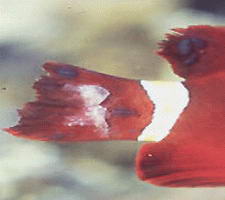
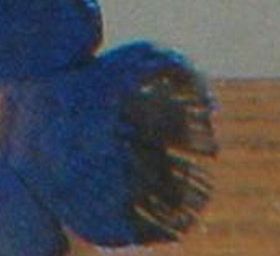
- Causes
Aeromonas, Pseudomonas, Vibrio bacteria - Symptoms
This bacterial infection causes erosion or rotting of the fins and the fin rays. The base of the fins reddens. In an advanced stage, it spreads to the skin causing bleeding to the gills. - Treatment
You can remove uneaten food, do a partial water change, and change the activated carbon in your filter.The antibiotics furanace, augmentin, and ciprofloxin may be effective.Recommended treatments: Melafix, Furanase, Furan-2, Maracyn, Maracyn-Two and Maracyn Plus.


Fish tuberculosis, wasting disease
- Causes
Mycobacterium bacteria - Symptoms
There’s really no external sign for this kind. If your fish looks fine from the outside appearance and looks healthy, it will be hard to recognize if it is internally infected.Fish that are infected though may live a year or more. Skin lesions, emaciation, labored breathing, scale loss, frayed fins and loss of appetite are all signs of this infection. Unfortunately, by the time these symptoms are recognized, it is probably too late to save the fish. - Treatment
This bacteria are transmitted orally through raw infected fish flesh, detritus, and feces of the infected fish. They can also infect skin wounds and lesions.The best treatment is prevention. Try not to feed raw fish and shellfish to your saltwater fish. Antibiotics, including kanamycin, erythromycin, and streptomycin, can be used.If the saltwater aquarium is heavily infected with this type, it must be sterilized and the water should be discarded.
No products found.
Vibriosis, ulcer disease
- Causes
Vibriobacteria - Symptoms
Variety of symptoms are associated with this disease. They can include lethargy, darkening of color, anemia, ulcers on the skin and lower jaw, bleeding of the gills, skin and intestinal track, clouded eyes, loose scales, pale gills and sudden death. - Treatment
This bacteria commonly go straight to the intestinal tracts of a healthy fish. They become dangerous only when stress allows infection.Poor water quality, crowding, excessive handling, and copper treatments are common causes of stress in saltwater aquarium fish. Immersion treatments with antibiotic compounds have met with some success.
Viral disease
Viruses are microscopic organisms that thrive by invading the cells of their hosts. In most cases, there are no treatments for the few viral diseases of the saltwater aquarium.
Here are our list of viral fish diseases and treatments.
Cauliflower or Lymphocystis
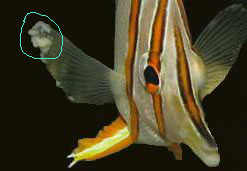
- Causes
Cystivirusvirus - Symptoms
Fin and body lesions are raised, whitish, warty and have a lumpy texture like a cauliflower. It may take three to four weeks for these lesions to reach their full size.The infection is not really fatal, but it can be transmitted to other fish in the saltwater aquarium. - Treatment
The only treatment is to isolate the fish immediately and let the fish’s immune system deal with the infection. This may take as long as several months. Other hobbyist scrape the lesion off the fish.
Fungal disease
Fungi are plan-like organisms. Some are parasitic on fishes.
Ichthyophonus disease, whirling disease
- Causes
Ichthyophonus fungus - Symptoms
These fungi goes to the internal organs, infecting the kidney, heart, spleen and liver.Signs include emaciation, spinal curvature, darkening or paling of the skin, roughening of the skin, fin erosion, and skin ulcers. Erratic swimming behavior can be a symptom too. - Treatment
This parasitic organism has a complex life cycle. The fungal cysts are usually ingested by the fish, where thy burst and enter the bloodstream, infecting the internal organs.Fishes that has this kind of disease typically die up to two months after being infected. Treatment is hard because of the internal nature of this disease.The infected fish should be removed right away from the aquarium to prevent other fishes from becoming infected. Recommended treatments: Rid-Ich+ or Probiotic Marine Formula. For scaless fish:Rid-Ich+ or Ich-Attack.

Exophiala disease
- Causes
Exophialafungus - Symptoms
Lethargy, disorientation, and abnormal swimming are the signs. - Treatment
No treatment is known. The best thing to do is to isolate the fish to prevent others fishes from contracting the fungus.
Parasitic Infestations
Marine velvet
- Causes
The dinoflagellate protozoan Amyloodinium ocellatum - Symptoms
You can usually see the infection on the gills then it spreads to the skin. It becomes dull, patchy and velvet-like. White spots are visible on section of intact skin.The fish’s behavior may include fasting, gasping, scratching against objects, and sluggishness. Death can occur in as little as 12 hours if infected. Tangs, clownfish, and angelfish are especially susceptible. - Treatment
The organism has three stages to its life cycle and only one of them is parasitic. No effective treatment is known, but copper-based products and some antibiotics are effective.A freshwater dip sometimes digs out the parasites from the host but does not kill them. Treatments are often dragged and the entire aquarium must be treated to fully destroy the infestation.
Marine white spot, cryptocaryoniasis, marine ich

- Causes
The ciliate protozoan Cryptocaryon irritans - Symptoms
Early signs are fasting, cloudy eyes, troubled breathing, excess skin mucus and pale skin. White spots appear on the skin, gills, eyes and death usually follows within a few days. - Treatment
White spot organisms are hard to control. The freshwater dip may be effective in killing parasite on the fish but does little to the aquarium. Prolonged immersion in copper products is the most effective treatment.
Uronema disease
- Causes
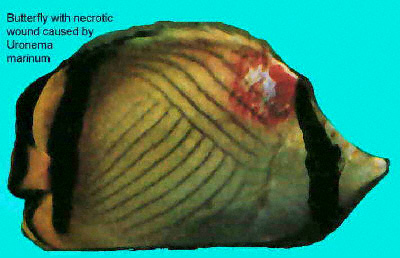
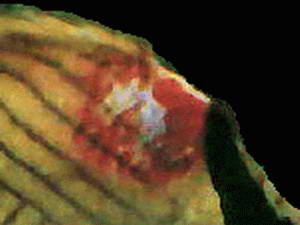
The ciliate protozoan Uronema marinum - Symptoms
External ulcers, muscle and skin bleeding, lethargic behavior, cloudy eyes, and sloughing of the skin are signs. They usually die right away if infected because of the impaired circulation of the gills. - Treatment
Freshwater bath followed by prolonged immersion in a formalin bath a day later is effective.
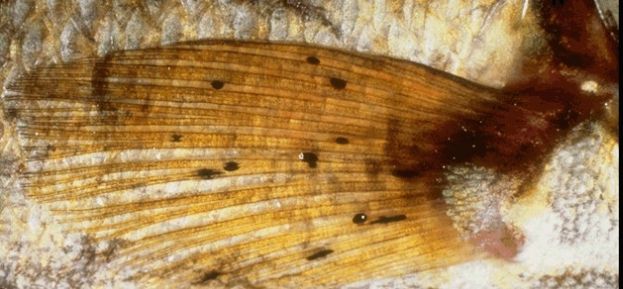
Tang turbellarian disease, black spot
- Causes
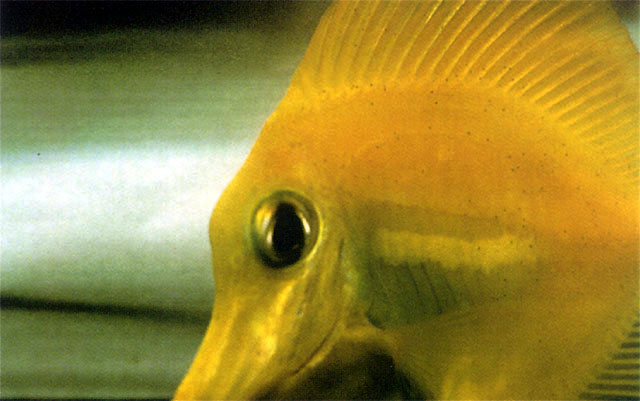
Paravortex flatworms - Symptoms
Even if the name implies that only tangs are infected, this is not the case. Many can be infected by this flatworm.The early phase, the organism would look like numerous dark spots over the fins, gills, and body. Other signs include fastening, listlessness, paling or whitish skin, and scratching against objects. - Treatment
As most parasitic infestations, crowding allows the disease to spread to other fish in the aquarium. Freshwater bath, triclorfon, formalin or praziquantel immersion can be effective.
Tremode infestation

- Causes
Monogenetic trematode worms - Symptoms
Many species of this worms are too small to see without a microscope. They normally infect gills, eyes, skin, mouth and anal opening.The infected fishes usually rub themselves against objects in the aquarium, trying to remove these parasites. These often causes damage that leads to bacterial infections. - Treatment
Immersion in fresh water, mebendazole, praziquantel or trichlorion is effective against trematodes.
Crustacean infestation

- Causes
Copepod, isopod, and argulid crustaceans - Symptoms
Most of these tiny, crab-like organisms are visible to the naked eyes. Copepods remain fixed in the same position while isopods are argulids move over the surface of the fish, causing tissue damage.Fishes that are infected swim erratically, rub against objects in the aquarium and jump. Bacteria infect lesions. - Treatment
Remove the ones that are infected immediately. Remove the decorations as well and dry them to kill the egg masses or immerse them in 2 percent bleach solution for two hours.Treat the infected fish with fresh water, trichlorfon or malathion baths.
Other health problems
Just when you thought there could be no more, here are a couple more that you need to be aware of.
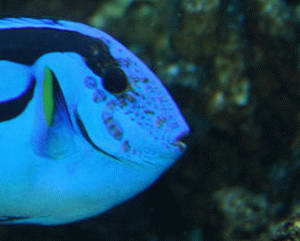
Head and lateral line errosion
- Causes
Poor water quality, nutrient deficiency, possibly a parasite - Symptoms
Like the freshwater disease called hole-in-the-head, holes develop and enlarge in the sensory pits of the head and down the lateral line on the body.The disease progress slowly and the fish does not seem to behave differently. Advanced stages can lead to bacterial infection and death. - Treatment
There are no specific treatment, but some recommended the use of the freshwater antibiotic flagyl. Check your water quality and make the necessary adjustments. Make sure that you are also meeting the fish’s nutrional needs. Get a variety of food for their diet and add vitamin supplements to their food.
Poisoning
- Causes
Multiple causes including buildup of nitrogenous compounds (ammonia, nitrite), household chemicals (smoke, cleaners, fumes) and tap water constituents (heavy metals, chloramines) - Symptoms
Low levels of toxins in the water stress the fish that can lower their resistance.Higher levels causes abnormal behavior such as darting movements, jumping, and gasping at the surface of your aquarium water. - Treatment
Be sure that activated carbon is used to remove toxins. Do a water change, about 20-40% of water should be replaced.
Return from Saltwater Fish Diseases and Treatments to Main Page
* Disclaimer: Saltwater-Aquarium-Online-Guide.com is a participant in the Amazon Services LLC Associates Program, an affiliate advertising program designed to provide a means for sites to earn advertising fees by advertising and linking to amazon.com, amazon.co.uk, amazon.ca. Amazon and the Amazon logo are trademarks of Amazon.com, Inc. or its affiliates. We may receive a small commission if you click on one of our links and make a purchase. Thank you for supporting Saltwater-Aquarium-Online-Guide.com and helping me make it the best site possible!
Last update on 2024-04-23 / Affiliate links / Images from Amazon Product Advertising API